

Your client ended the session by saying she’d made real progress, the exposure to the team meeting went better than expected, the post-event rumination only lasted a day instead of a week, and she’d actually slept through the night twice. Good session. Now you’re staring at a blank SOAP note and trying to reconstruct all of it before your next client in 15 minutes.
For anxiety treatment, SOAP notes aren’t just a documentation requirement; they’re a clinical tool. The Subjective/Objective split does something particularly useful for anxiety: it separates the client’s internal experience (worry, fear, avoidance) from what you actually observed in the room (affect, posture, engagement, symptom shifts). That distinction is exactly what payers, supervisors, and licensing boards need to see.
This guide gives you two full SOAP note examples for anxiety one for GAD, one for Social Anxiety Disorder a printable section-by-section template, a format comparison table, and answers to the questions most therapists actually have about anxiety documentation.
What Are SOAP Notes?
SOAP stands for Subjective, Objective, Assessment, and Plan. Originally developed in medical settings, SOAP notes have become a standard progress note format across behavioral health, outpatient therapy, integrated care, and psychiatry. Each section captures a distinct layer of clinical information:
- Subjective (S): What the client reports, symptoms, concerns, and experiences in their own words.
- Objective (O): What the clinician observes, affect, behavior, appearance, engagement, and standardized measure scores.
- Assessment (A): The clinician’s clinical interpretation, diagnosis, symptom severity, progress trajectory, and safety screening.
- Plan (P): Next steps interventions planned for the next session, homework assigned, referrals, crisis resources, and next appointment.
SOAP notes are particularly common in settings where clinicians work alongside medical providers, integrated behavioral health, federally qualified health centers, and hospital-based outpatient programs because the format maps directly to how medical documentation is structured.
Why SOAP Notes Work Well for Anxiety Documentation
Anxiety is both a subjective experience and an observable clinical presentation. A client with GAD will tell you their mind won’t stop racing, that’s Subjective. You’ll also notice that they’re sitting rigid in the chair, speaking quickly, and scanning the room, that’s Objective. SOAP notes create a natural structure for capturing both, which is clinically important and payer-necessary.
Medical necessity is built in. The Subjective section documents presenting symptoms; the Objective section documents observable clinical signs; the Assessment section documents the diagnosis and severity. Together, they constitute the medical necessity documentation payers require.
Symptom trajectory is easy to track. Including a GAD-7 score in both the Subjective and Assessment sections gives you an objective measure to compare session over session. A payer reviewing for continued care authorization can see at a glance whether symptoms are improving, stable, or worsening, and whether continued treatment is clinically justified.
Cross-disciplinary communication. If your client is also seeing a prescriber or PCP, SOAP notes are the format they’ll recognize. It makes coordination of care cleaner.
What to Capture in Every Anxiety SOAP Note
Regardless of the anxiety subtype, these clinical elements should appear in every session note:
- Anxiety severity rating. GAD-7 score where possible, or a self-reported 0–10 scale. Document the current score alongside the prior session score to show trajectory.
- Specific anxiety content. Not just “anxiety", what specific worries, fears, or triggers were reported? Work performance, health, relationships, social evaluation? Specificity supports clinical depth and demonstrates individualized care.
- Physical symptoms. Muscle tension, racing heart, shortness of breath, GI distress, sleep disruption. These are clinically significant and often diagnostic.
- Avoidance and safety behaviors. Avoidance is the maintenance mechanism in most anxiety disorders. Document what the client is avoiding, the impact on functioning, and any safety behaviors being used.
- Interventions and technique specificity. Not “CBT was used.” Rather: “Therapist guided client through cognitive restructuring of catastrophic predictions related to job performance using a thought record.”
- Client response and engagement. Affect shifts during session, engagement level, willingness to complete in-session exercises, insight demonstrated.
- Safety screening. For clients with anxiety, note whether SI was screened and the outcome. Also document any safety concerns related to panic attacks, severe avoidance, or functional impairment.
Anxiety SOAP Note Examples
Example 1: Generalized Anxiety Disorder (GAD)
Client: Adult, Generalized Anxiety Disorder — Session 9
SUBJECTIVE
Client presented reporting elevated anxiety throughout the past week, rating average worry level at 7/10. Identified primary worry themes as work performance, finances, and a parent's recent health diagnosis. Stated: "I can't stop the worrying, it's like my brain never turns off." Reported poor sleep averaging 5 hours per night, morning muscle tension in shoulders and jaw, and difficulty concentrating at work resulting in two missed deadlines. GAD-7 score at session start: 15 (moderate to severe). Client denied panic attacks and denied suicidal ideation.
OBJECTIVE
Client appeared tense throughout the session; posture was rigid and client frequently shifted in seat and adjusted clothing. Affect was anxious and constricted initially, softening during the latter half of session. Mood described as "stressed and overwhelmed." Speech was rapid at session start, slowing noticeably following relaxation exercise. Client maintained adequate eye contact and engaged throughout the full 50-minute session. No observed panic symptoms.
ASSESSMENT
Client continues to meet criteria for Generalized Anxiety Disorder (F41.1), with moderate to severe symptom burden. GAD-7 score of 15 represents a 2-point decrease from Session 8 (17), indicating early positive response to treatment. Primary cognitive distortions identified: catastrophizing related to work performance and hypervigilance around parent's health. Sleep disruption and somatic tension remain secondary treatment targets. Worry management skills are being introduced and require consolidation. No acute safety concerns. Therapeutic alliance strong.
PLAN
Continue weekly individual therapy. Therapist introduced the worry time technique; client will practice daily 15-minute scheduled worry period and log outcomes. Progressive muscle relaxation guided in session, client will use audio recording between sessions for daily practice. Next session will focus on cognitive restructuring of catastrophic predictions related to work performance. Sleep hygiene to be addressed in session 11. Client instructed to use 988 Suicide & Crisis Lifeline if distress escalates significantly. Next appointment: [date].
Example 2: Social Anxiety Disorder
Client: Adult, Social Anxiety Disorder — Session 14
SUBJECTIVE
Client reported a difficult week following a mandatory work presentation. Stated: "I was convinced everyone thought I was incompetent the entire time." Described significant anticipatory anxiety in the days before the event (rated 9/10) and shame-based post-event rumination for approximately three days afterward. Disclosed active avoidance of an upcoming team meeting, stating it feels "too similar" to the presentation. Client denied suicidal ideation. GAD-7 administered: score 12 (moderate).
OBJECTIVE
Client appeared visibly embarrassed when recounting the work event; brief facial flushing observed. Affect was anxious and somewhat constricted throughout the first third of session, gradually opening as session progressed. Demonstrated good verbal insight and engaged actively in collaborative discussion. Arrived on time. No overt avoidance behaviors noted within the session. Session duration: 50 minutes.
ASSESSMENT
Client continues to meet criteria for Social Anxiety Disorder (F40.10). Post-event processing and anticipatory avoidance remain primary treatment targets. Positive development: client completed the presentation despite high anticipatory anxiety, representing a significant exposure success. Avoidance of the upcoming team meeting signals a return to safety behaviors following a stressful exposure. Client demonstrates growing insight into cognitive patterns but has not yet generalized this insight to post-event processing. No acute safety concerns.
PLAN
Exposure hierarchy reviewed; client agreed to attend team meeting without avoidance as the next planned exposure step. Pre-exposure cognitive preparation strategies reviewed. Cognitive restructuring worksheet assigned, focusing specifically on post-event processing and counteracting shame-based rumination. Therapist will introduce interoceptive exposure techniques in session 15 to address anticipatory physical symptoms. Next session will debrief team meeting exposure and address residual rumination patterns. Next appointment: [date].
Anxiety SOAP Note Template
Use this as your section-by-section documentation reference. Adapt to your preferred EHR format or print as a clinical desk reference.
Section | What to Include |
|---|---|
S — Subjective | Client-reported symptoms in their own words. Specific anxiety triggers, worry themes, avoidance behaviors, physical symptoms (muscle tension, racing heart, shortness of breath). GAD-7 score or self-rated anxiety (0–10). Direct quotes where clinically relevant. |
O — Objective | Clinician observations: affect, posture, speech rate, eye contact, level of engagement, session duration. Any observable anxiety symptoms during session (restlessness, fidgeting, facial flushing). Standardized measure scores if administered in session. |
A — Assessment | Diagnosis with ICD-10 code. Current symptom severity and trajectory (improving / stable / worsening) with reference to prior session. Cognitive distortions identified. Functioning impact. Safety screening outcome. Clinical formulation updates if applicable. |
P — Plan | Specific interventions for next session. Homework or between-session assignments with detail. Referrals made or pending. Any changes to treatment frequency or modality. Crisis resources provided if applicable. Next appointment date. |
On GAD-7 frequency: Administer at every session or at minimum every 4 sessions. Consistent GAD-7 tracking gives you objective symptom data, supports medical necessity documentation, and creates a clear longitudinal record of treatment response.
SOAP vs. DAP vs. BIRP vs. GIRP for Anxiety
Your practice setting, payer requirements, and EHR will typically guide format choice. Here’s how the options compare for anxiety documentation:
Format | Best For | Anxiety Strength | Limitation |
|---|---|---|---|
SOAP | Integrated care, psychiatry, multi-disciplinary | S/O split captures internal experience vs. observable signs naturally for anxiety | Can feel lengthy for solo outpatient work |
DAP | Outpatient individual therapy, faster documentation | Concise; Assessment integrates clinical picture quickly | Less separation between what client reports and what clinician observes |
BIRP | Behavioral health, managed care | Response section directly tracks symptom shifts and exposure outcomes | Less formal emphasis on diagnostic reasoning |
GIRP | Goal-monitored, managed care settings | Goal section ties exposure/coping work to treatment plan targets | Requires well-written treatment plan goals to function well |
When SOAP is the right choice: You work in integrated care alongside medical providers. Your payer or EHR defaults to SOAP. You want a formal Assessment section that allows for diagnostic reasoning and clinical formulation. Your client has comorbid medical conditions where the S/O distinction matters.
Common Mistakes in Anxiety SOAP Notes
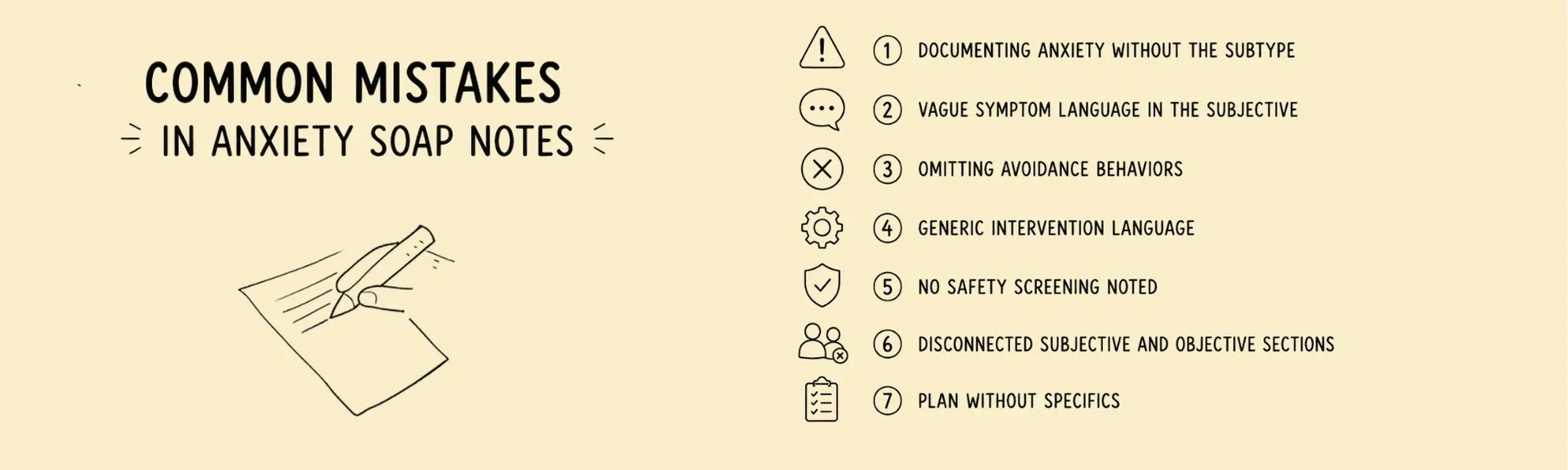
- Documenting anxiety without the subtype. "Anxiety" is not a diagnosis. Your Assessment section should include the specific diagnosis and ICD-10 code: F41.1 (GAD), F40.10 (Social Anxiety Disorder), F41.0 (Panic Disorder), F40.00 (Agoraphobia). This distinction matters for billing, treatment planning, and clinical accuracy.
- Vague symptom language in the Subjective. "Client reports anxiety" tells a reviewer almost nothing. "Client rated anxiety 7/10, endorsed persistent worry about work performance and financial instability, reported muscle tension and 5 hours of sleep per night" is clinically useful. Be specific.
- Omitting avoidance behaviors. Avoidance is the central maintenance mechanism in anxiety disorders. If it’s not documented, the clinical picture is incomplete. Document what the client is avoiding, how long they’ve been avoiding it, and the impact on daily functioning.
- Generic intervention language. "CBT techniques used" is insufficient. "Therapist guided client through behavioral experiment to test the prediction that colleagues would notice and judge visible anxiety symptoms during team meeting" describes an actual clinical intervention.
- No safety screening noted. Anxiety and suicidality co-occur more than most clinicians document. Screening for SI should be documented in every session, and for clients with severe avoidance or functional impairment, note that screening occurred and was negative.
- Disconnected Subjective and Objective sections. If the client reports severe anxiety (Subjective: 8/10, racing heart, can’t sleep) but the Objective section says "client appeared calm and engaged," that discrepancy needs a clinical explanation. Don’t leave unexplained contradictions in the record.
- Plan without specifics. "Continue therapy" is not a plan. "Next session will focus on cognitive restructuring of catastrophic predictions about health-related anxiety; client will complete one behavioral experiment before session" is a plan.
How AI Can Write Your Anxiety SOAP Notes
A full caseload of anxiety clients means a full caseload of SOAP notes, each one requiring accurate symptom capture, specific intervention language, clinical reasoning in the Assessment, and a documented plan. Writing that from scratch after every session is a significant time cost, especially late in the day when cognitive load is highest.
AI-assisted documentation tools like Supanote are built specifically to reduce that burden. After a session, you give Supanote a verbal summary, describing what the client reported, what you observed, what interventions you used, and what you’re planning next, and the AI generates a structured SOAP note in your chosen format in under a minute.
What AI handles well for anxiety SOAP notes:
- Separating your session summary into clean S/O/A/P sections
- Applying specific, clinical language to symptom descriptions and intervention documentation
- Maintaining a consistent note structure and format across all clients
- Flagging when sections are underdeveloped or missing required fields
- Supporting SOAP, DAP, BIRP, GIRP, and PIRP formats switchable per client or session
Where your clinical judgment is irreplaceable:
- The Assessment section requires your clinical reasoning. AI will structure what you tell it, but the diagnostic impression, formulation, and clinical decision-making are yours.
- Avoidance patterns, nonverbal cues, and the quality of the therapeutic alliance live in the room, not in a transcript. Give Supanote specific input, and you get a specific note.
- Safety documentation must reflect your actual assessment. AI prompts you to complete safety fields, but the content and clinical call are yours to make and document.
Supanote is HIPAA-compliant with a signed BAA, supports all major note formats, and is built for mental health providers in private practice and group clinic settings. Free plan available with no credit card required.
Try Supanote Free — Save 4+ Hours on Notes Every Week →
Frequently Asked Questions
1. Do I need to document a safety screening for every anxiety session?
Yes, and for anxiety clients specifically, this is more clinically important than it might seem. Anxiety disorders and suicidal ideation co-occur at rates that are frequently underestimated in practice. For clients with panic disorder, severe avoidance, or significant functional impairment, a brief SI screen is best practice at every session. Document the outcome explicitly: "Client denied suicidal ideation, plan, or intent." Absence of documentation does not constitute a negative screen in a licensing board review.
2. What ICD-10 codes should I use for anxiety in the Assessment section?
Common anxiety diagnoses with their ICD-10 codes: Generalized Anxiety Disorder (F41.1), Social Anxiety Disorder (F40.10), Panic Disorder (F41.0), Agoraphobia without Panic Disorder (F40.00), Specific Phobia (F40.10-F40.298 depending on type), Separation Anxiety Disorder (F93.0). Include the specific code in your Assessment section, not just "anxiety" as this is required for billing and clinical record accuracy. If the diagnosis has changed or requires updating, document your clinical rationale for the change.
3. How do I document an exposure therapy session in a SOAP note?
Exposure sessions have rich clinical content that should be captured specifically. In the Subjective: what the client reported about anticipatory anxiety before the exposure and any pre-session avoidance urges. In the Objective: observed affect and physical symptoms during the exposure, engagement level, whether the client completed or terminated early. In the Assessment: peak anxiety rating reached, how it declined, clinical significance of the session in the exposure hierarchy, and any avoidance behaviors noted. In the Plan: next exposure step, how the client will consolidate this experience between sessions, any cognitive restructuring work to accompany the exposure.
4. How often should I administer the GAD-7?
The GAD-7 evidence base supports administration at every session or at regular intervals (e.g., every 4 sessions minimum) as part of measurement-based care. Many managed care payers now expect standardized outcome measurement as a documentation requirement for anxiety treatment. Administering the GAD-7 takes under 2 minutes and gives you objective symptom tracking that directly supports continued care authorization and treatment decision-making. Document the score in the Subjective and reference the trajectory in the Assessment.
5. What if my client’s anxiety is getting worse despite treatment?
Document it accurately and add your clinical reasoning. Note the GAD-7 alongside the prior score. In the Assessment, identify what the escalation suggests: need to adjust intervention approach, increase session frequency, refer for medication evaluation, or re-examine the case conceptualization. Document the specific clinical actions you took in response a referral made, a treatment plan update, or a discussion with the client about a higher level of care. Honest documentation of worsening symptoms with clinical reasoning is a good practice. Minimizing symptom escalation in notes is a documentation and clinical risk.
6. How do I document a session where the client avoided their homework exposure?
Document it honestly and show your clinical response. In the Subjective: what the client reported about the avoidance and their rationale. In the Objective: affect when discussing it, any avoidance behaviors in the session itself. In the Assessment: clinical interpretation of the avoidance is it a natural part of the treatment process, a sign of insufficient hierarchy scaffolding, or something requiring a different approach? In the Plan: how you’re adjusting the exposure hierarchy or intervention strategy. A note that reflects honest documentation of avoidance and adaptive clinical response demonstrates clinical competence, not failure.
7. Can I use SOAP notes for telehealth anxiety sessions?
Yes, with standard telehealth additions. Note the session modality ("session conducted via HIPAA-compliant video platform"), confirm the client was located in the state where you’re licensed, and document that telehealth consent was obtained. For exposure work via telehealth, note any modifications made to the standard exposure approach (e.g., in-vivo exposures conducted by client in their environment while therapist provides coaching via video). Some payers require a telehealth modifier on the corresponding CPT billing claim.
8. What’s the difference between what goes in Subjective vs. Objective for anxiety?
This is one of the most common points of confusion in SOAP note writing. The rule is simple: Subjective is what the client tells you, their reported worry level, their described avoidance, their physical symptoms as they experience them, their direct quotes. Objective is what you observe and affect as you see it, posture, speech rate, eye contact, and behavioral observations during the session. A client can report feeling "completely calm" (Subjective) while displaying rigid posture, rapid speech, and a visibly tense affect (Objective). Document both accurately; don’t collapse them.
9. Do I need to document medical necessity for every anxiety session?
Effectively, yes, every progress note is a medical necessity document. Payers reviewing for continued care authorization are looking for evidence that: the client still has symptoms (Subjective), those symptoms are observable and clinically significant (Objective), the diagnosis remains active and treatment is indicated (Assessment), and there is a clear clinical plan (Plan). A SOAP note that does all four well is a medical necessity document by design. The most common reason anxiety claims are denied on audit is vague or incomplete symptom documentation, not the diagnosis itself.
10. Is there AI software that writes anxiety SOAP notes automatically?
Yes. Purpose-built mental health documentation tools like Supanote generate SOAP-formatted notes from a post-session verbal summary or recording. The AI produces a structured first draft; you review and finalize. Supanote is HIPAA-compliant, supports SOAP, DAP, BIRP, GIRP, and PIRP formats, and is designed for mental health providers in private practice and group clinic settings.
