The Mental Status Exam is one of the first things one learns in training - and one of the hardest to document efficiently. This guide gives you everything you need: all 10 components, copy-paste descriptors, printable cheat sheets, and real examples you can use today.
In this blog, we'll cover the following:
Key components of a mental status examination
A quick-reference summary table and printable cheat sheet
A guide to conducting each part of the exam with examples, descriptors and assessment techniques
MSE vs MMSE - what's the difference
Practical challenges and solutions
Cultural considerations in MSE assessment
If instead you're looking for a comprehensive guide on how to do a biopsychosocial examination, refer to this guide here.
Key Takeaways
The MSE covers 10 domains: appearance & behavior, attitude, motor activity, speech, mood & affect, thought process, thought content, perception, cognition, and insight & judgment.
It takes 15–30 minutes and should be conducted at every initial assessment, with brief check-ins each subsequent session.
The MSE is different from the MMSE — the MSE is a broad psychiatric evaluation; the MMSE is a scored screening tool for cognitive impairment.
AI tools like Supanote can now auto-generate structured MSE documentation directly from therapy sessions, saving hours of note-writing each week.
MSE Cheat Sheet (PDF)
A printable one-page overview of all 10 MSE components, what to assess, and normal presentations....
The Mental Status Exam is a structured assessment of a client's cognitive and emotional functioning at a specific point in time. It serves several crucial purposes:
Provides a baseline of the client's mental state
Aids in differential diagnosis
Helps track changes in symptoms over time
Informs treatment planning and interventions
Facilitates communication with other healthcare providers
You'd want to do a brief mental status exam at the beginning of any new client relationship, to identify potential mental health conditions.
Components of the Mental Status Exam
A comprehensive mental status exam typically covers the following 10 components:
Appearance and Behavior
Attitude
Motor Activity
Speech
Mood and Affect
Thought Process
Thought Content
Perception
Cognition
Insight and Judgment
We cover each of these in depth later in this article.
MSE Components - Quick reference Table
MSE Component
What to Assess
Normal Presentation
Appearance & Behavior
Age, grooming, attire, posture, eye contact
Well-groomed, appropriate dress, good eye contact, open posture
Attitude
Cooperativeness, engagement level
Cooperative, readily engages in assessment
Motor Activity
Psychomotor agitation/retardation, tics, tremors
Normal psychomotor activity, no unusual movements
Speech
Rate, volume, tone, coherence
Normal rate, volume, and tone; relevant and coherent
Alert and oriented ×4; attention, memory, and abstraction intact
Insight & Judgment
Understanding of condition; decision-making ability
Good insight into condition; sound judgment
What is a Mini Mental State Exam?
In contrast to the comprehensive mental status exam (MSE), the "mini" mental state examination (MMSE) is a specific, structured screening tool designed primarily to assess cognitive impairment.
It consists of a series of questions and tasks that focus on orientation, registration, attention and calculation, recall, and language.
MSE vs MMSE: Differences
Below is a simple comparison table that differentiates between an MSE and MMSE
Aspect
MSE (Mental Status Examination)
MMSE (Mini-Mental State Examination)
Purpose
Broad psychiatric evaluation of current mental state
Screening tool for cognitive impairment (especially dementia)
Scope
10 domains: appearance, behavior, speech, mood, affect, thought process, thought content, perception, cognition, insight & judgment
Focused on cognitive domains: orientation, recall, attention, calculation, language, visuospatial
Format
Narrative description with clinical observation and descriptors
Standardized 30-point scored questionnaire
Assessment Length
15–30 minutes depending on complexity
5–10 minutes
Who Uses It
Psychiatrists, psychologists, therapists, social workers
Primary care providers, neurologists, geriatricians
Detecting and monitoring cognitive decline (e.g., Alzheimer's, delirium)
How to Conduct the Mental Status Exam
1. Appearance and Behavior
In this section, observe and document the following:
Age, gender, ethnicity
Attire and grooming
Posture and eye contact
Any notable physical characteristics or abnormalities
Typical Example: "35-year-old Caucasian male, appears stated age. Well-groomed, dressed in business casual attire. Makes appropriate eye contact and sits with an open posture." Atypical Example: "35-year-old Caucasian male, appears older than stated age. Disheveled appearance with stained clothing and strong body odor. Avoids eye contact and sits hunched over with crossed arms."
Common Descriptors:Clean, neat, well-groomed, unshaven, disheveled, dirty, unkempt, body odor, hair brushed/unbrushed, fashionable, bizarre, inappropriate for weather/setting, appears stated age, appears older/younger than stated age, good eye contact, poor eye contact, intermittent eye contact, open posture, closed posture, slouched
Assessment Prompts:
"Can you tell me about your typical daily routine, including how you prepare for the day?"
"How would you describe your energy levels lately?"
2. Attitude
Assess the client's approach to the interview: Cooperative, guarded, hostile, seductive, etc.
Typical Example: "Client demonstrates a cooperative attitude, readily engaging in the assessment process." Atypical Example: "Client exhibits a guarded and somewhat hostile attitude, providing minimal responses and frequently challenging the purpose of questions."
Note the body language and any unusual movements or behaviors:
Psychomotor agitation or retardation
Tics, tremors, or unusual mannerisms
Typical Example: "Client displays normal psychomotor activity, with no unusual movements noted." Atypical Example: "Client exhibits significant psychomotor agitation, frequently shifting in the seat, tapping feet, and fidgeting with hands."
"Have you noticed any changes in your energy levels or ability to sit still recently?"
"Do you ever experience any involuntary movements or sensations?"
4. Speech
Here we evaluate the client's speech patterns. Look at the following elements -
Rate: pressured, rapid, normal, slow
Volume: loud, soft, normal
Tone: monotone, expressive
Content: relevant, coherent, tangential
Typical Example: "Speech is of normal rate, volume, and tone. Content is relevant and coherent." Atypical Example: "Speech is rapid and pressured, with increased volume. Content is tangential, frequently veering off-topic."
"How would you describe your typical speaking style?"
"Have others commented on changes in your speech recently?"
5. Mood and Affect
Here we evaluate a patient's emotional state.
Mood: This is the client's self-reported emotional state. We use the client's subjective descriptions of their emotions.
Affect: This is the observed expression of emotion. Remember the ABCs of Affect: A - Affect: The outward expression of emotion B - Behavior: How the emotion is expressed through actions C - Cognition: The thoughts associated with the emotion
This mnemonic helps you remember that affect isn't just about facial expression — it encompasses behavior and cognition too
When assessing affect, consider:
Range: full, restricted, flat
Intensity: normal, blunted, exaggerated
Stability: stable, labile
Appropriateness to content
Typical Example: "Client reports mood as 'pretty good.' Affect is full range, appropriate to content, and congruent with reported mood." Atypical Example: "Client reports feeling 'numb.' Affect is flat, with minimal facial expression or vocal inflection, incongruent with the emotional content being discussed."
Common Mood Descriptors:Euthymic, depressed, sad, anxious, irritable, angry, elated, euphoric, hopeless, apathetic, dysphoric, fearful, guilty
Common Affect Descriptors: Full range, restricted, constricted, flat, blunted, labile, congruent, incongruent, appropriate, inappropriate, expansive, intense, tearful
Assessment Prompts:
"How would you describe your mood over the past week?"
"On a scale of 1-10, with 10 being the best you've ever felt and 1 being the worst, where would you rate your mood right now?"
"Have you noticed any changes in your ability to feel pleasure or interest in activities?"
6. Thought Process
Here we evaluate the patient's thought processes, like the flow and organization of thoughts:
Logical and goal-directed
Circumstantial
Tangential
Flight of ideas
Loose associations
Thought blocking
Typical Example: "Thought process is logical and goal-directed, with client able to provide clear and relevant responses."
Atypical Example: "Thought process is tangential, with client frequently going off on unrelated tangents and struggling to return to the original topic."
Common Descriptors:Logical, goal-directed, linear, coherent, circumstantial, tangential, loose associations, flight of ideas, word salad, perseverative, blocking, derailment, incoherent, disorganized, impoverished, rapid, distractible
Assessment Prompts:
"Can you walk me through your typical day, from morning to night?"
"How would you describe your ability to concentrate and focus lately?"
7. Thought Content
In this section, assess for:
Delusions
Obsessions
Phobias
Suicidal and homicidal ideation
Typical Example: "No evidence of delusions, obsessions, or phobias. Denies current suicidal or homicidal ideation." Atypical Example: "Client expresses paranoid delusions, believing that the government is monitoring their thoughts through implanted devices. Reports frequent intrusive thoughts about contamination."
Common Descriptors:No delusions/obsessions/phobias, suicidal ideation (passive/active, with/without plan or intent), homicidal ideation, paranoid delusions, grandiose delusions, ideas of reference, obsessive thoughts, rumination, preoccupation, phobias, overvalued ideas, thought insertion/withdrawal/broadcasting
Assessment Prompts:
"Do you ever have thoughts that you can't seem to get out of your head?"
"Have you ever felt like others can read your thoughts or control your mind?"
"Do you ever have thoughts of harming yourself or others?"
Typical Example: "No reported or observed perceptual disturbances." Atypical Example: "Client reports auditory hallucinations of voices commenting on their actions. Also describes episodes of depersonalization, feeling detached from their body."
"Have you ever seen, heard, or felt things that others don't seem to experience?"
"Do you ever feel disconnected from yourself or your surroundings?"
9. Cognition
Here, use the GOAL CRAMP mnemonic:
G - General alertness O - Orientation (person, place, time, situation) A - Attention and concentration L - Language C - Calculation R - Right/left orientation A - Abstraction M - Memory (immediate, recent, remote) P - Praxis
Typical Example: "Alert and oriented x4. Attention, concentration, and memory appear intact. Able to perform simple calculations and demonstrate abstract thinking." Atypical Example: "Oriented to person and place, but confused about time. Attention span is limited, struggling with serial 7s. Recent memory impaired, unable to recall events from earlier in the day."
Common Descriptors:Alert, oriented ×4 (person/place/time/situation), oriented ×3, confused, disoriented, poor recall, intact memory, distractible, impaired attention, able to perform serial 7s, unable to perform serial 7s, intact abstraction, concrete thinking, poor concentration, good fund of knowledge
Assessment Prompts:
"Can you tell me today's date, including the day, month, and year?"
"I'm going to say three words. Please repeat them back to me, and try to remember them because I'll ask you to recall them later: Apple, Penny, Table."
"Can you count backwards from 100 by 7s?"
10. Insight and Judgment
Assess the client's
Understanding of their condition (insight)
Decision-making ability (judgment)
Typical Example: "Client demonstrates good insight into their anxiety, recognizing its impact on daily functioning. Judgment appears sound, as evidenced by seeking professional help and adhering to treatment recommendations." Atypical Example: "Client lacks insight into their manic symptoms, believing increased energy and risky behaviors are signs of improved mental health. Judgment is impaired, as demonstrated by recent impulsive financial decisions."
Common Descriptors:Good/fair/poor insight, intact/impaired judgment, aware of illness, denies illness, understands need for treatment, limited awareness, sound decision-making, impulsive decision-making
Assessment Prompts:
"What do you think might be causing the difficulties you're experiencing?"
"How do you think these issues are affecting your life?"
"What steps have you taken to address these problems?"
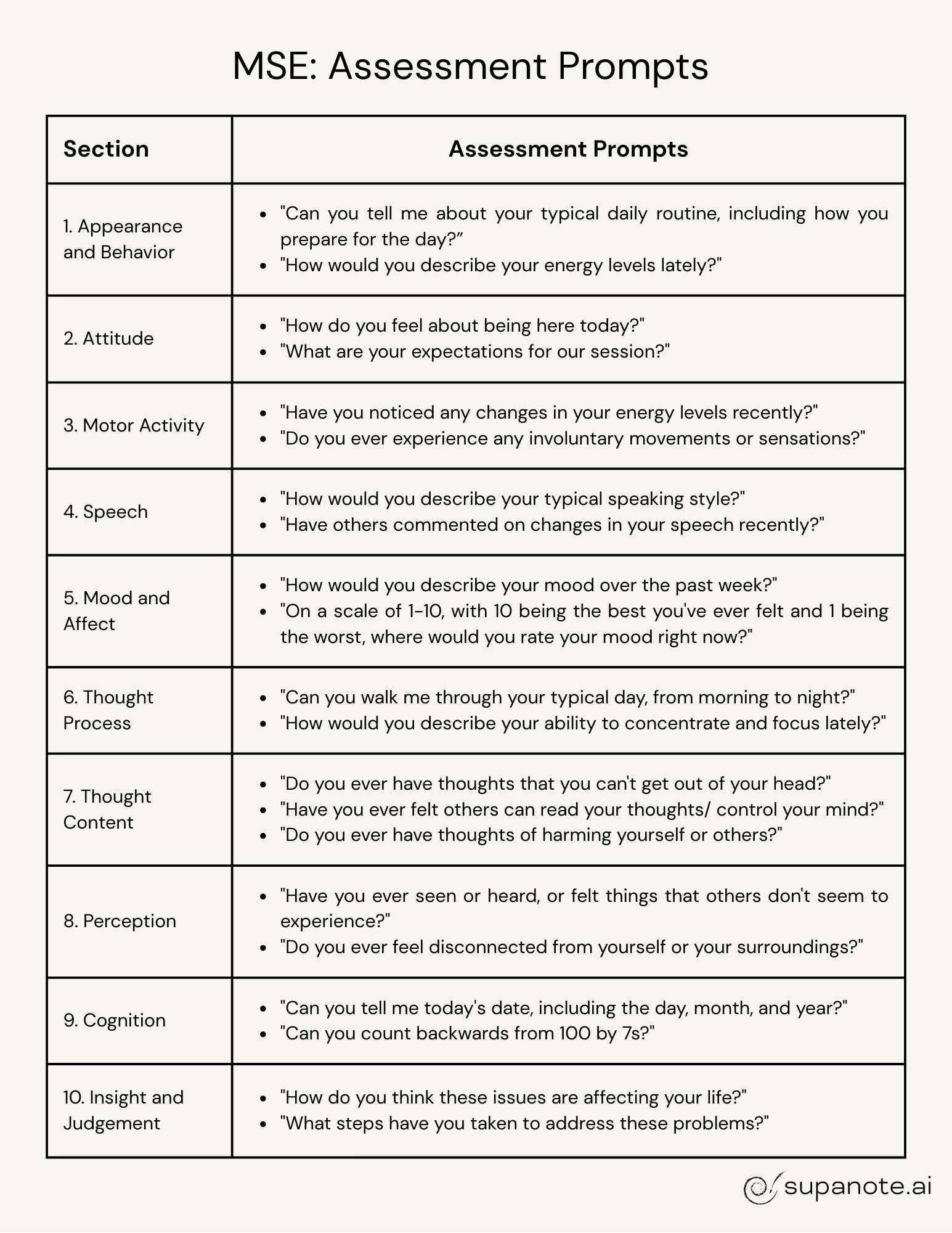
Download - MSE Cheat Sheet with Assessment Prompts
Ready-to-use questions for each MSE component. Print it and keep it in your session folder....
Here's a comprehensive example of an MSE write-up:
"Jane Doe is a 42-year-old African American female who presented for evaluation of depressive symptoms. She appeared her stated age, was neatly groomed, and dressed appropriately in casual attire. Her eye contact was intermittent, and she displayed psychomotor retardation, moving and speaking slowly.
Jane's attitude was cooperative but guarded. Her speech was soft and slow, with increased latency in responses. She described her mood as "hopeless," and her affect was constricted, predominantly sad, and congruent with reported mood.
Thought process was logical and goal-directed, albeit slow. Thought content revealed passive suicidal ideation without plan or intent, and feelings of worthlessness. She denied hallucinations, delusions, or obsessions.
Jane was alert and oriented x4. Attention and concentration were mildly impaired, struggling with serial 7s but able to spell "WORLD" backwards. Recent memory was intact, recalling 3/3 objects after 5 minutes. Abstract thinking and judgment were fair.
Jane demonstrated good insight into her depression, recognizing the need for treatment. No obvious cognitive deficits were noted during the examination."
Using AI for Mental Status Exam
Today, AI tools can automatically write a high-quality mental status exam. One exciting development in this area is the automation of therapy notes using artificial intelligence, which offers significant time-saving potential for therapists.
Automating MSE notes with Supanote
Supanote is an AI platform that can automatically write mental status exams for you, directly from your sessions, covering all the topics above. Here are some key features and benefits:
Direct Session Capture: Supanote can listen directly to therapy sessions and automatically generate a high-level MSE based on the conversation.
Built-in MSE Template: The system comes with a pre-configured MSE note template, ensuring that all generated notes follow the correct format and structure.
HIPAA Compliance: Supanote is designed to be HIPAA-compliant, providing a high level of security for sensitive patient information. This compliance is crucial for maintaining patient confidentiality and meeting regulatory requirements.
EHR Integration: Supanote directly integrates with your EHR - so notes and MSEs directly get filled within your EHR, eliminating the need to copy-paste. Commonly used EHRs that integrate with Supanote are Simple Practice, Therapy Notes, Therapy Appointment, TherapyIQ, Procentive, Practice Fusion, IntakeQ, Sessions health and so on.
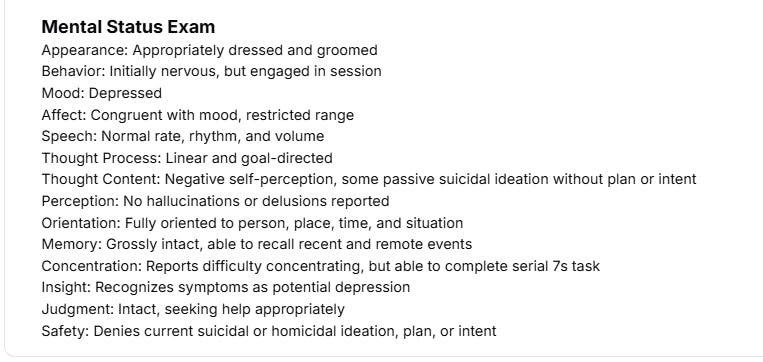
Below is an example of a sample MSE auto-generated by Supanote AI based on a session. You can also edit the template on Supanote to include the specific sections you'd like.
The gap in Supanote and other AI tools is that they don't yet process the visuals - e.g., the patient's facial expressions. So while you will get an MSE, it is best to go through and edit it and update with your own observations (the notes are directly editable).
The MSEs generated by these tools are not intended to be a replacement to your clinical judgement, but as supporting tools to save time for clinicians.
Save 4 Hours Every Week on Notes
Generate HIPAA-compliant drafts in seconds and focus more on your clients, not paperwork.
Many clinicians document MSE findings within a SOAP note format. Here’s how the MSE maps to each section: Need help drafting a SOAP note? Try the SOAP note generator.
S (Subjective): Client reports feeling “hopeless and exhausted” for the past three weeks. Describes difficulty sleeping, loss of appetite, and withdrawal from social activities. States, “I just don’t see the point anymore.”
O (Objective - this is where MSE findings go): - Appearance: 42-year-old female, appears stated age, casually dressed, adequate grooming
- Behavior: Cooperative but guarded, psychomotor retardation noted
- Speech: Soft, slow rate, increased latency
- Mood: “Hopeless” (client’s words)
- Affect: Constricted, predominantly sad, congruent with mood
- Thought Process: Linear, goal-directed, slow
- Thought Content: Passive SI without plan or intent; denies HI; feelings of worthlessness
- Perception: No hallucinations or illusions reported
A (Assessment): Symptoms consistent with Major Depressive Episode. Passive suicidal ideation present without plan or intent - low acute risk, moderate chronic risk. Functioning has declined over three weeks.
P (Plan): Continue weekly individual therapy (CBT). Safety plan reviewed and updated. Refer for psychiatric medication evaluation. Follow up on SI at next session. Client to call crisis line if thoughts intensify.
Mental Status Exam Template and Cheat Sheets
Below is a simple mental status exam cheat sheet you can use to refer to the different components of a mental status exam. It's a reference guide you can look at to make sure you covered all the individual components, and what's expected in each section.
Also see below another cheat sheet with the assessment prompts/ questions you can use for each of the sections
Tips for Conducting an Effective MSE
Start with open-ended questions to build rapport before moving to more specific inquiries.
Use natural transitions between topics to cover different aspects of the MSE.
Pay attention to non-verbal cues throughout the session.
Practice active listening and reflection to encourage client disclosure.
Be prepared to pause the assessment if the client becomes distressed or needs a break.
Document observations in real-time or immediately after the session to ensure accuracy.
Regularly review and refine your MSE skills through peer consultation and continuing education.
Practical Challenges and Solutions
1. Time Management
Challenge: Conducting a thorough MSE can be time-consuming, especially in busy clinical settings.
Solution: Prioritize key components based on presenting concerns. Integrate MSE questions naturally into the conversation. Use standardized brief cognitive assessments when appropriate.
2. Balancing Standardization and Individualization
Challenge: Adhering strictly to a standardized MSE format may miss important individual nuances.
Solution: Use the standard MSE as a framework, but allow flexibility to explore areas of particular concern for each client. Document any deviations from the standard format and the rationale for them.
3. Building Rapport While Assessing
Challenge: Formal assessment can sometimes feel impersonal or intimidating to clients.
Solution: Explain the purpose of the MSE to clients. Use a conversational tone and integrate assessment questions naturally into the discussion. Pay attention to the client's comfort level and take breaks if needed.
4. Cultural Competence
Challenge: Interpreting MSE findings accurately across diverse cultural backgrounds.
Solution: Continuously educate yourself on cultural differences in mental health presentation. When unsure, ask clients about their cultural background and how it might influence their experiences. Consult with colleagues or cultural experts when needed.
Common Pitfalls to Avoid
Rushing through the assessment
Making assumptions based on appearance or initial impressions
Overlooking subtle signs of cognitive impairment or emotional distress
Failing to consider cultural factors in interpretation
Using jargon or technical terms when documenting, rather than clear, descriptive language
Cultural Considerations in MSE Assessment
When conducting an MSE, it's crucial to consider cultural factors that may influence a client's presentation.
Here are some examples:
Eye Contact: In some Asian and Middle Eastern cultures, direct eye contact with authority figures may be considered disrespectful. A client averting their gaze might be showing respect rather than indicating depression or anxiety.
Emotional Expression: Some cultures value emotional restraint, while others encourage more open expression. A client from a culture that emphasizes stoicism may appear to have a restricted affect, even when experiencing intense emotions.
Spiritual Beliefs: In certain African, Native American, or other indigenous cultures, hearing the voice of a deceased relative might be considered a comforting spiritual experience rather than a hallucination.
Thought Content: Cultural beliefs about spirits, ancestral communication, or supernatural phenomena could be misinterpreted as delusions in a Western context.
Personal Space: Cultures differ in their norms for personal space. A client who stands very close or far away may be adhering to their cultural norms rather than displaying unusual behavior.
Always strive to understand the client's cultural background and how it might influence their presentation. When in doubt, respectfully ask the client about their cultural practices and beliefs.
Conclusion
Mastering the Mental Status Exam is an ongoing process that requires practice and refinement. By consistently applying the principles and techniques outlined in this guide, you'll enhance your clinical acumen and provide more targeted, effective care for your clients. Remember, the MSE is not just a checklist but a dynamic tool that, when used skillfully, can provide invaluable insights into your client's mental health and guide your therapeutic interventions.
Keep this cheat sheet handy as a quick reference during your assessments, and don't hesitate to adapt it to your specific practice needs and client populations. With time and experience, conducting a comprehensive MSE will become second nature, allowing you to focus on building strong therapeutic relationships and delivering high-quality mental health care.
And if documentation is eating into your session time, try Supanote free to auto-generate MSE notes from your sessions.
FAQs
Q. How long should a Mental Status Exam take?
A: Typically, a comprehensive mental status exam takes about 15–30 minutes. But don’t sweat it if it takes longer when you’re just starting out. With practice, you’ll get faster and smoother!
Q. Do I need to cover every component of the mental status exam in every session?
A: Not necessarily. While it’s ideal to cover all bases, you can focus on the most relevant areas based on your client’s presenting issues. Just make sure to document why you skipped certain parts.
Q. How often should I conduct a mental status exam?
A: At minimum, do a full MSE during the initial assessment. After that, it’s good practice to do brief check-ins each session and a more thorough review periodically or when you notice significant changes.
Q. What if my client refuses to participate in certain parts of the MSE?
A: Respect their boundaries, but document their refusal and any observations you can still make. Try to understand why they’re hesitant — it might provide valuable clinical insights.
Q. How do I explain the purpose of an MSE to my clients?
A: Keep it simple and friendly. You might say something like, “I’m going to ask you a few questions to get a clearer picture of how you’re doing right now. This helps us understand your current needs better and plan the most effective treatment.”
Q. What is the 10-point MSE?
A: The 10-point MSE refers to the ten standard domains assessed during a Mental Status Examination: 1) Appearance & Behavior, 2) Attitude, 3) Motor Activity, 4) Speech, 5) Mood & Affect, 6) Thought Process, 7) Thought Content, 8) Perception, 9) Cognition, and 10) Insight & Judgment. Together, these ten areas provide a comprehensive snapshot of a client’s current mental functioning.
Q. How do I describe eye contact in a mental status exam?
A: Eye contact can be described as good, poor, fleeting, intense, avoidant, intermittent, or consistent. For example, “fleeting eye contact” might suggest anxiety or discomfort, while “intense, unbroken eye contact” could indicate agitation or a manic state. Always consider cultural factors — in some cultures, avoiding eye contact is a sign of respect, not a clinical finding.
Q. How do I describe speech in a mental status exam?
A: Describe speech across multiple dimensions: rate (rapid, normal, slow), volume (loud, soft, normal), tone (monotone, expressive, tremulous), fluency (articulate, slurred, hesitant), and relevance (coherent, tangential, circumstantial). For example: “Speech is slow in rate, soft in volume, with a monotone quality and increased latency in responses.”
Q. How should I document MSE findings in progress notes?
A: MSE documentation should be clear, concise, and objective. Use standardized descriptors under each domain. Many clinicians integrate MSE findings into the Objective (O) section of SOAP notes. Use the client’s exact words in quotes for mood. Document both what you observed (affect) and what the client reported (mood) separately. Always document safety concerns (SI/HI) thoroughly.
Q. Are there any standardized forms for conducting an MSE?
A: While there’s no universally standard form, many clinics and institutions have their own templates. Check with your workplace or professional association for recommended templates. AI tools like Supanote also come with built-in MSE templates that ensure consistent, structured documentation.
Q. How detailed should my MSE notes be?
A: Aim for clear, concise, and objective observations. Use direct quotes when relevant, and always document any safety concerns thoroughly.
Q. Can I use an MSE with children or adolescents?
A: Absolutely! Just adjust your language and expectations to be developmentally appropriate. Play-based assessments can be particularly useful for younger kids.
Q. What if I suspect cognitive impairment during an MSE?
A: If you notice significant cognitive issues, it’s a good idea to use more specific cognitive screening tools (like the MMSE or MoCA) and consider referring for neuropsychological testing.
Q. What are the attitude examples for a mental status exam?
A: Attitudes observed during an MSE may include: cooperative, friendly, hostile, evasive, suspicious, defensive, apathetic, guarded, engaged, withdrawn, passive, demanding, overly familiar, or reluctant. These descriptors help capture how the client interacted with you during the evaluation and can provide important clinical context.
Q. How do I improve my MSE skills?
A: Practice, practice, practice! Conduct MSEs regularly, seek feedback from colleagues, review recorded sessions if possible, and stay updated with continuing education. The more you do it, the more natural it becomes.
Remember, these FAQs are just the tip of the iceberg. Keep asking questions, stay curious, and never stop learning.
Folstein, M. F., Folstein, S. E., & McHugh, P. R. (1975). "Mini-mental state": A practical method for grading the cognitive state of patients for the clinician. Journal of Psychiatric Research, 12(3), 189-198. https://doi.org/10.1016/0022-3956(75)90026-6
Karasz, A., & Singelis, T. M. (2009). Qualitative and mixed methods research in cross-cultural psychology. Journal of Cross-Cultural Psychology, 40(6), 909-916. https://doi.org/10.1177/0022022109349172
Sam T is the Founder and CEO of Supanote. She writes about behavioral health documentation, care workflows, and the operational realities of modern therapy practice, drawing on deep exposure to U.S. mental health systems, RCM, and clinician-led care delivery.
Reviewed by
Nick Morvan LMFT
Automate Your MSE and Save Time
Let AI write mental status exams from your sessions.